Domestic Water Production Technology in Vietnam
Domestic water in Vietnam is produced from two main sources: surface water and groundwater. Their composition differs, so the treatment technologies differ, but both rely on sedimentation, filtration and disinfection.
Key points
- Two supply sources: surface water (rivers, ponds, lakes) and groundwater (underground water).
- Surface water: coagulant (such as alum) and coagulant aid are added, followed by sedimentation, filtration and chlorine disinfection.
- Groundwater: usually contains Fe and Mn, so the simplest and most common method is aeration, followed by sedimentation and filtration.
Current sources of domestic water supply
Water for drinking and daily use is currently produced from two main sources: surface water and groundwater.
Surface water means natural water sources such as rivers, streams, ponds and lakes.

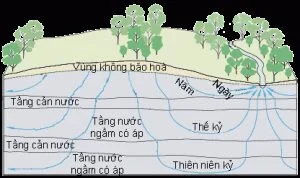
Groundwater (underground water) is water stored underground in sedimentary soil and rock layers.
Because the substances contained in the water differ, the treatment technology for domestic water from these two sources also differs; however, both use sedimentation, filtration and disinfection.
Common domestic water production technologies
Surface water treatment technology
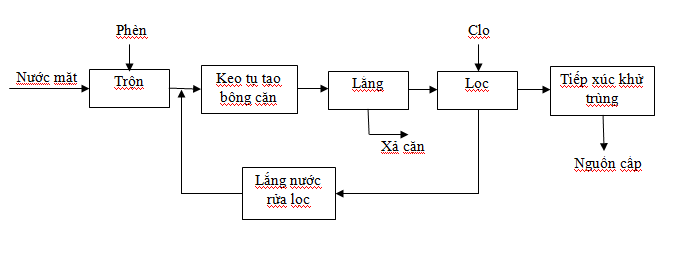
Surface water contains a lot of settleable and dissolved matter, so once it enters treatment a coagulant (such as alum) and a coagulant aid are added. These bind the dirt and dissolved solids into larger flocs that settle easily and are discharged through the sludge discharge valve at the outlet of the settling tank and on the filter media layers. After the filter tank, the water goes to a contact tank, where chlorine is dosed to disinfect the water before it is supplied to users.
Depending on the composition and properties of the surface water, equalisation tanks, flotation and similar units can also be used for effective treatment.
Groundwater treatment technology
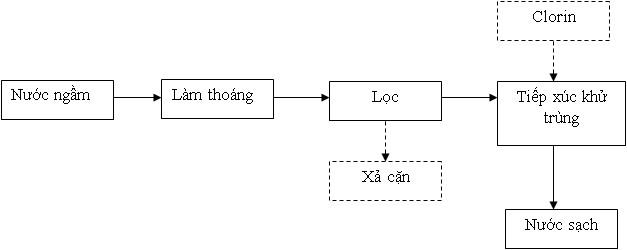
Groundwater treatment uses unit processes similar to surface water treatment. However, because groundwater usually contains Fe and Mn, the simplest and most common method is aeration: using oxygen in the air (or supplied air) to convert Fe(II) into precipitating Fe(III), which can then be removed by sedimentation and filtration. Mn is harder to oxidise than Fe, so an oxidant or a catalytic filter medium is usually needed as well.
Depending on the substances in the groundwater, auxiliary structures such as reaction tanks can also be built to ensure the best output water quality.
Although treatment plants can treat water to the required output standard, the quality of the water and of the supply pipes is increasingly deteriorating, so the water reaching consumers may not be of guaranteed quality, affecting daily life.
CAD’s staff are trained in depth by manufacturer experts and provide technical consulting, repair, maintenance and replacement of consumables on site at your plant. See also our water valves and industrial valves for water treatment and supply systems.
Frequently asked questions
What sources is domestic water produced from?
From two main sources: surface water (rivers, streams, ponds, lakes) and groundwater (underground water).
How is surface water treated?
A coagulant (such as alum) and coagulant aid are added to form flocs, followed by sedimentation, filtration and chlorine disinfection in a contact tank.
How is groundwater containing Fe and Mn treated?
The simplest and most common method is aeration to convert Fe(II) into precipitating Fe(III), which is then removed by sedimentation and filtration.