Electromagnetic Flowmeter: Principle and Installation
An electromagnetic flowmeter (also called an electromagnetic flow meter or electronic water meter) measures flow by electromagnetic induction under Faraday’s law, with an accuracy from ±0.50%. It has no moving parts and needs little maintenance, but it only measures well when the pipe is full and the fluid is electrically conductive.
Key points
- Principle: electromagnetic induction (Faraday’s law); the voltage across the electrodes is proportional to the fluid velocity.
- Accuracy ranges from 0.3% to 0.5% of the measured value; some high-end models state up to ±0.2%.
- The fluid must have a conductivity above 5 µS/cm and the pipe must be full.
- Straight pipe upstream of the meter (typically about 5 times the pipe diameter, 5xD, depending on make and model); preferably install vertically with flow from bottom to top.
General concept of the electromagnetic flowmeter
The electromagnetic flowmeter goes by several other names: electronic flowmeter, electromagnetic flow meter, electronic water meter, magnetic flow measuring device. All of these names refer to the same type of instrument.
Today the device is increasingly common in industry and daily life. It measures flow accurately and is used for applications with a relatively long service life, stable operation and large flow rates. Its measurement accuracy is as good as ±0.50%.
Businesses are gradually switching from mechanical meters to this type. The initial cost is higher than a mechanical meter, but accurate, timely information lets operators adjust the system immediately and find effective solutions for the business and the user.
Some technical specifications
- Body: cast iron, carbon steel, aluminium, stainless steel
- Measurement type: instantaneous flow, totalised flow
- Display: integral LCD or remote display
- Working pressure: 16 bar
- Applicable media: clean water, wastewater, conductive chemicals, light slurries…
- Analog signal: 4 – 20 mA
- Contacts: 316L stainless steel
- Liner: PTFE
Operating principle
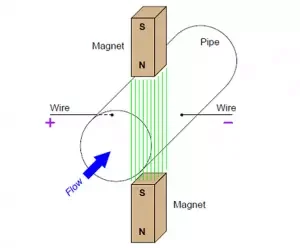
The electromagnetic flowmeter works on the principle of electromagnetic induction, applying Michael Faraday’s law. Inside the meter body, coils placed on both sides of a hollow measuring pipe create a magnetic field perpendicular to the flow. When an electrically conductive fluid flows through the pipe, a voltage appears at the electrodes mounted on both sides of the measuring pipe, proportional to the fluid velocity.
The electrodes are connected to a circuit board containing a central microprocessor. This electronic processor performs the calculations and outputs the required parameters to the display.
One point to note: the meter body may be made of a conductive material, but its liner must be an insulator, to prevent the voltage from dissipating into the pipe.
Meters using a pulsed DC field work as follows: the device switches the magnetic field off and measures the voltage at the electrodes, then switches the field back on and measures again. This cycle repeats several times per second, which eliminates offset and drift. The result is the difference between the field-on and field-off readings, meaning that the voltage on the sensors is proportional to the flow velocity of the fluid; this approach is much more accurate than other velocity-measuring methods.
The electromagnetic flowmeter measures fluid velocity with fairly high accuracy and is used to measure flow over a relatively long period. Its accuracy ranges from 0.3% to 0.5% of the measured value. Some high-end models even state an accuracy of up to ±0.2%.
Points to note when using it in modern measurement
Measuring environment of the fluid
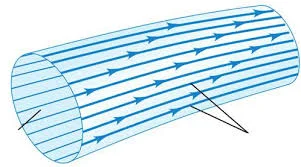
The electromagnetic flowmeter has a wide measuring range and is widely used in industry.
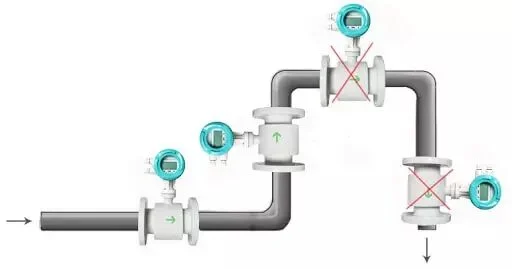
- The device only works truly effectively when the pipe is full of fluid; a partially filled measuring pipe causes significant errors. To reduce this, design the pipe in a U shape so that it always stays full of water.
- The device does not work well when air or gas is mixed into the fluid being measured. Air in the pipe must be removed before use, with an air-separation device.
- Most importantly, the fluid flowing through the body must have a conductivity above 5 µS/cm (microsiemens per centimetre), because the internal resistance of the sensor must be much smaller than the input resistance of the measuring instrument.
- For fluids with very high conductivity (brine, seawater), choose a suitable model and configuration as the manufacturer recommends.
Installation notes
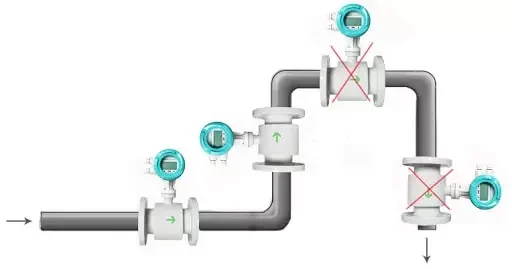
- Install on a straight pipe run: the electromagnetic flowmeter needs a shorter straight run than other flow measuring devices, usually about 5 times the measuring-pipe diameter (5xD) upstream and 2-3xD downstream, depending on make and model; check the datasheet. It is best installed vertically, or lengthwise with the fluid flowing from bottom to top. This limits swirl and air entering the pipe.
- Choose a suitable measuring range; do not operate the meter at maximum or minimum velocity.
- Grounding the instrument is extremely important during installation.
- Working temperature and pressure must be within the meter’s specifications; do not push the device to its maximum rating, as this affects its operation in the long term.
Conclusion
The electromagnetic flowmeter is becoming more and more common in industry and daily life. It is gradually replacing other flow measuring devices because of its fully hollow construction with no moving parts, so it rarely needs maintenance while remaining very accurate.
CAD’s staff are trained in depth by manufacturer experts and provide technical consulting, repair, maintenance and replacement of consumables on site at your plant. See also our flow measuring devices and the Siemens electromagnetic flowmeter.
Frequently asked questions
What principle does an electromagnetic flowmeter use?
It uses electromagnetic induction under Faraday's law: a conductive fluid flowing through a magnetic field generates a voltage across the electrodes that is proportional to the fluid velocity.
How accurate is an electromagnetic flowmeter?
Accuracy ranges from 0.3% to 0.5% of the measured value; some high-end models state up to ±0.2%.
How much straight pipe does an electromagnetic flowmeter need?
Usually about 5 times the measuring-pipe diameter (5xD) upstream and 2-3xD downstream, depending on make and model (check the datasheet); it is best installed vertically with flow from bottom to top.
What conditions must the fluid meet for an electromagnetic flowmeter?
The fluid must be conductive, above 5 µS/cm, and the pipe must be full; the device works poorly when air or gas is mixed into the fluid.