UV vs IR Flame Sensors: How They Differ and Which to Choose
The flame sensor is the “eye” of the burner controller: it reports whether a flame is present so the controller can hold or cut the gas. There are three common technologies: ultraviolet (UV), infrared (IR) and the flame rod (ionisation). UV responds fastest but is weaker in smoke; IR suits oil flames and longer distances but can be fooled by the hot background of a furnace; the flame rod works on gas flames only. The right choice depends on the fuel, the environment and how the flame is viewed.
Key points
- A flame emits UV (about 1% of the spectrum), visible light and infrared (about 90% of the spectrum). Each type of sensor “sees” a different part of it.
- UV: fastest, suits gas flames, loses performance in heavy smoke or at distance; use a self-checking type when the burner runs continuously.
- IR: better at long range and with oil flames; red-hot furnace walls can disturb the signal.
- Flame rod: sits directly in a gas flame, needs a stable flame and a large enough grounding area.
- A burner flame sensor is different from a fire flame detector, which gives an alarm for fires in an area.
What a flame sensor does
In a combustion system the flame sensor is connected to the burner controller. At start-up it confirms the pilot flame and then the main flame; while running, if the flame is lost for longer than the flame failure response time (FFRT, from under 1 second to about 4 seconds depending on the standard and design), the controller closes the shut-off valves. Conversely, if the sensor reports a flame when there should be none, the controller must lock out and refuse to start.
What a flame emits
A flame radiates over a wide band made up of ultraviolet, visible light and infrared. Ultraviolet makes up only about 1% of the total spectrum, is most abundant in the first third of the flame and increases as flame temperature rises. Infrared makes up about 90%, mostly in the last two thirds of the flame. Hot furnace parts such as refractory also emit infrared when above about 1000°F (roughly 540°C). Each fuel gives a different spectrum:
| Fuel | Infrared | Visible | Ultraviolet |
|---|---|---|---|
| Oil, air atomised | High | High | Medium |
| Oil, steam atomised | High | High | Low |
| Gas, air premixed | Low | Low | High |
| Gas, not premixed | Medium | Medium | Medium |
UV sensors
A UV sensor uses a quartz detector tube filled with gas and containing two electrodes. When ultraviolet from the flame enters the tube, the gas ionises and the tube pulses; the controller counts the pulses to estimate flame intensity. The tube responds only in the short-wavelength band of about 200 – 300 nm (“solar blind”) so that light from outside the flame does not disturb it.
- Strengths: the fastest response of the technologies; works well on gas flames, especially premixed gas.
- Limits: performance drops with distance to the flame and in smoky surroundings; it can respond to ignition sparks, welding arcs, halogen lamps and very hot refractory (above about 2000°F, roughly 1100°C).
- “False flame” fault: an ageing UV tube can pulse with no flame present. The controller only detects this when the burner shuts down and restarts, so for burners that run continuously a self-checking type is used, with a shutter that blocks the UV periodically.
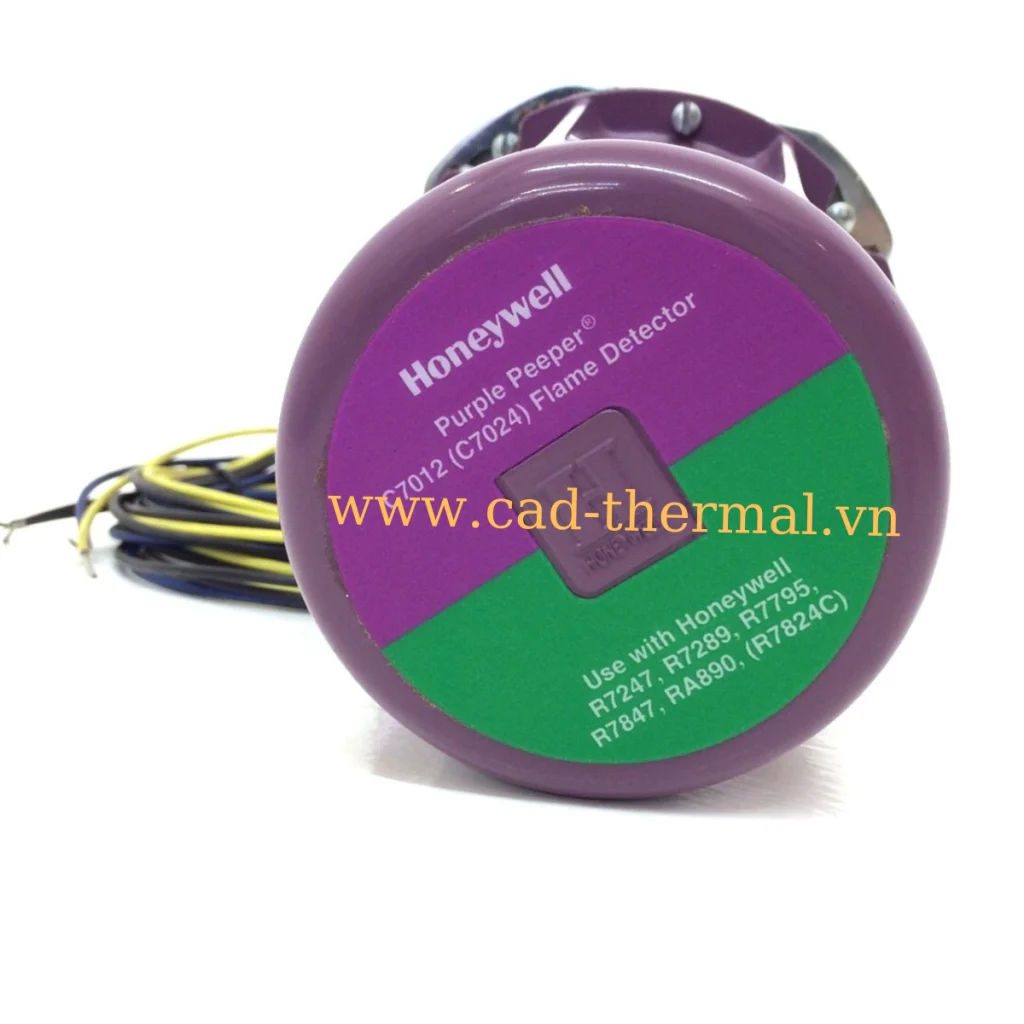
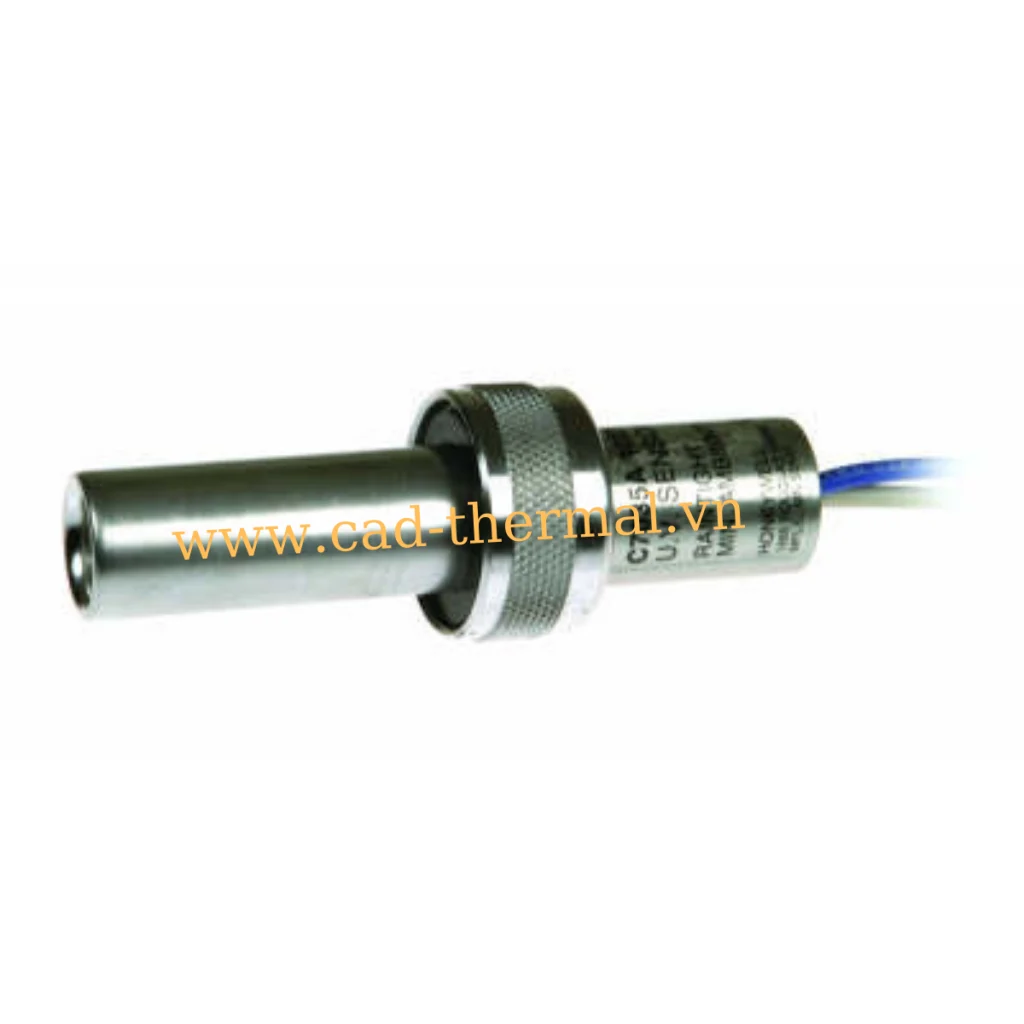
CAD’s range includes two Honeywell UV sensors: the C7024E1001 (24 VDC solid-state self-checking type used with the R7824C amplifier; the shutter blocks UV 12 times a minute to test the tube; can be mounted horizontally, vertically or at any angle) and the Minipeeper C7035A1080 (end viewing, NEMA 4 and 4X enclosure, field-replaceable UV tube, 5 psi maximum pressure, used with the R7249A, R7290A, R7749B and R7849A/B amplifiers).
IR sensors
An IR (and visible light) sensor cannot rely simply on whether radiation is present, because a hot furnace also emits infrared. It measures the flicker frequency of the flame, typically with a PbS (lead sulphide) photoconductive cell; flame flicker can range from about 5 Hz to over 200 Hz. By analysing flicker the sensor can tell a burning flame from a steady hot background.
- Strengths: better at long range; suits oil flames and non-premixed gas flames; less weakened by smoke than UV.
- Limits: low-frequency background radiation from furnace walls and other heat sources can saturate the photoconductive cell (“washout”), so the sensor can no longer track flicker; hot gas moving across refractory can also create false flicker. Aim at the ignition zone, avoid viewing the furnace background and adjust sensitivity if the controller allows.
Flame rod (ionisation)
A flame rod is a small metal rod placed in a gas flame. The flame makes the gas slightly conductive and the current through it is only a few microamps (typically 2 – 4 µA); a rectifying circuit lets the controller reject false signals caused by a short to ground or leakage. The rod is used on gas flames only, needs a stable flame and a grounding area considerably larger (generally about 4 times) than the rod. For example, the Kromschröder BCU 370 accepts both an ionisation signal of 1 – 28 µA and a UV signal of 1 – 35 µA.
UV, IR and flame rod compared
| Criterion | UV | IR | Flame rod |
|---|---|---|---|
| Principle | Ultraviolet radiation from the flame | Flicker frequency of infrared / visible light | Ion current through the flame |
| Suitable fuels | Gas (especially premixed); also used on oil | Oil; non-premixed gas | Gas only |
| Distance to flame | Effectiveness drops with distance | Good at long range | Placed directly in the flame |
| Smoky environment | Weaker | Better | Needs a stable flame; the shorter the rod the better |
| Main sources of interference | Ignition sparks, welding arcs, halogen lamps, very hot refractory | Hot furnace background, false flicker from gas movement | Short to ground / leakage resistance (rejected by the rectifying circuit) |
Continuously running burners and self-checking sensors
With a UV sensor, the dangerous fault is a tube stuck in the “flame present” state. A self-checking sensor has a shutter that blocks the UV periodically; the controller is designed to expect this interruption, and the test time must be shorter than the FFRT so it does not cause a nuisance shutdown. The applicable standard may require a self-checking type when the burner is not allowed to cycle for a specified period; check the specific requirements of NFPA 85, NFPA 86 or the project standard.
How to choose a flame sensor
- Fuel: premixed gas leans towards UV or a flame rod; oil towards IR; non-premixed gas can use either depending on conditions.
- Environment: smoke, dust and oil vapour weaken UV; a hot furnace background disturbs IR; arcs or sparks nearby disturb UV.
- Distance and view angle: aim at the root of the flame, through a sight tube or a correctly sized flange; where the flame is hard to see, a swivel mount can help.
- Operating mode: intermittent or continuous (whether a self-checking type is needed).
- Compatible controller and amplifier: each sensor works only with certain amplifiers, as the product pages list.
- Installation conditions: temperature, pressure at the sight tube, enclosure rating, cable length and type.
See the flame sensors group and the burner controllers of Honeywell.
Do not confuse with a fire flame detector
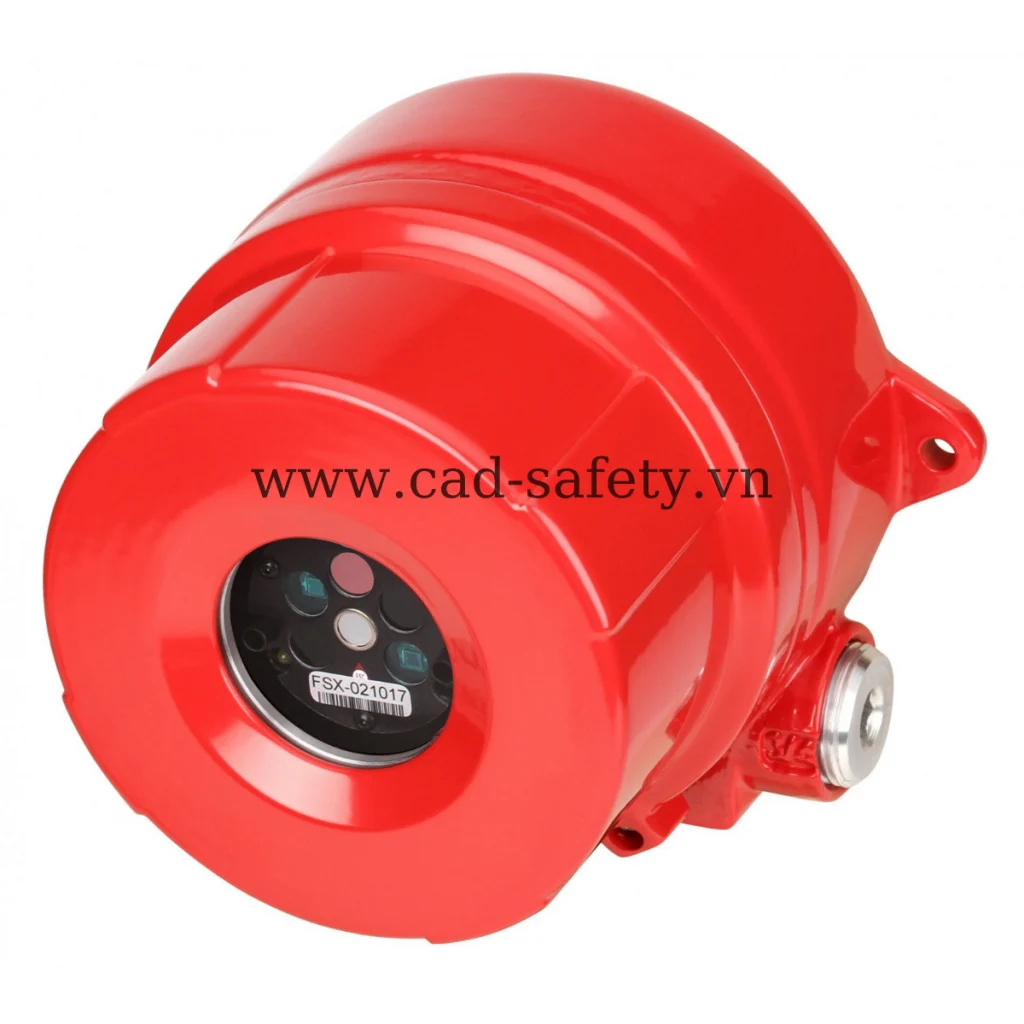
Besides sensors that supervise a burner flame, there are fire flame detectors used to detect an unwanted fire in an area such as a fuel store, pump station or process area. They do not control a burner; they give an alarm or an emergency shutdown signal. For example, the Honeywell FS24X infrared flame detector is a multi-spectrum detector (IR/IR/IR/visible) that detects both hydrocarbon and non-hydrocarbon fires; per its product page it has a detection time of 3 – 5 seconds for a 1 sq. ft. n-heptane fire at 30 m, an IP66 rating and SIL 2 capability. See also CAD’s Fire & Gas Detection solution.
Need to replace or select a flame sensor for an existing burner? CAD supplies genuine equipment with full CO/CQ documentation. Send the model / specifications and CAD will quote within 24 working hours: contact CAD.
Frequently asked questions
Can a UV sensor be used on a gas flame?
Yes. Gas flames, especially gas premixed with air, emit a lot of ultraviolet, so UV is a common choice. In a very hot furnace or where sparks and arcs are nearby, interference sources must be considered.
Why does an IR sensor still report a flame after the flame is out?
Red-hot refractory emits a lot of infrared, and hot gas moving across it can create flicker that looks like a flame. Aim at the ignition zone, avoid viewing the furnace background and adjust sensitivity if the controller allows.
When is a self-checking sensor needed?
When the burner runs continuously without cycling for a long time and the standard or design requires it. A self-checking sensor, such as the Honeywell C7024E used with the R7824C, has a shutter that blocks the UV periodically to prove the tube is still sensitive.
Can two sensors be used on one burner?
Per the Honeywell C7024E and C7035A product pages, two detectors can be wired in parallel to reduce nuisance shutdowns where the flame is hard to see. Confirm with the controller manufacturer and the applicable standard before wiring.