What Is a Burner Management System (BMS)? Role, Functions and How to Choose a Controller
A burner management system (BMS) is the dedicated safety control of a burner: it decides when purging, ignition and opening the gas are allowed, and it shuts the gas off the moment it sees an unsafe condition such as flame loss, abnormal gas pressure or insufficient combustion air. In practice the device is often called a burner controller or flame safeguard.
Note: “BMS” is also the abbreviation of Building Management System, a completely different field. The article separates the two meanings below.
Key points
- A burner BMS handles safety at start-up, during operation and at shutdown. Holding the air-gas ratio and adjusting output belong to the combustion control system.
- Core functions: monitoring interlocks, purging, time-limited ignition, continuous flame supervision, gas shut-off and lockout on a fault.
- It can be a dedicated microprocessor controller (a flame safeguard) or a programmed safety PLC.
- Reference standards: NFPA 85, NFPA 86, EN 746-2 (now EN ISO 13577-2) and EN 298 for burner control systems.
Burner BMS versus building BMS
The same abbreviation covers three very different systems, each controlling something else.
| Abbreviation | Full name | What it controls | At CAD |
|---|---|---|---|
| BMS | Burner Management System | Ignition sequence, flame supervision, interlocks and gas shut-off of a burner | The burner controllers group |
| BMS | Building Management System | HVAC, chillers, pumps, lighting and energy monitoring in a building | The building control (BMS) group and the BMS / HVAC Control solution |
| BMS | Battery Management System | Monitoring and protecting battery cells | Not related to this article |
When searching for products, add “burner” or “building” to the keywords.
What a burner BMS does
Monitoring interlocks and fuel
Before and during operation the BMS reads the permissive signals: the combustion air pressure switch, low/high gas pressure switches, high temperature or pressure limits and the emergency stop. One missing condition prevents start-up; losing one while running shuts the gas off.
Purge
Before ignition, the BMS runs the blower to clear leftover gas from the combustion chamber. For ovens and furnaces, NFPA 86 calls for a purge of at least four volumes of the system (the heating chamber and the passages connected to it), with the purge airflow maintained throughout the purge time.
Ignition and the trial for ignition
The BMS energises the ignition, opens the pilot valve (or the main gas valve directly on a direct-spark burner) and waits for the sensor to report a flame within the trial-for-ignition time. That time is set by the applicable standard and the manufacturer; the longest values are around 15 seconds depending on fuel and design. If no flame is proven in time, the BMS closes the gas and locks out.
Continuous flame supervision
Once there is a flame, the sensor keeps reporting its state. If the flame is lost for longer than the flame failure response time (FFRT), the BMS closes the shut-off valves. FFRT ranges from under 1 second to about 4 seconds depending on the standard and the design. The three common sensing technologies are the flame rod (ionisation), infrared sensors and ultraviolet sensors; see the flame sensors group in CAD’s range.
Safety shut-off, lockout and normal stop
On a fault the BMS closes the shut-off valves on the gas train and goes to lockout; to restart, someone must reset it manually after finding the cause. On a normal stop the BMS can run a post-purge before turning off the blower.
How a burner BMS differs from combustion control
The combustion control system adjusts the air and gas to hold the air-gas ratio over the whole firing range, usually through servos on the air and gas valves, with a PID loop on process temperature or pressure. The BMS is responsible only for safety. In practice many devices combine the two: for example the product page of the Kromschröder BCU 370 lists control of the fan and butterfly valves to modulate forced-air gas burners.
Types of burner BMS
| Type | Suited to | Characteristics |
|---|---|---|
| Dedicated microprocessor controller (flame safeguard) | A single burner or a small group of burners | Start-up sequence and flame supervision built in, usually certified for the burner safety function |
| Programmed safety PLC | Many burners, complex processes, deep integration with the plant control system | Flexible, but the designer must assure and commission the safety logic against the standards |
Burner controllers in CAD’s range
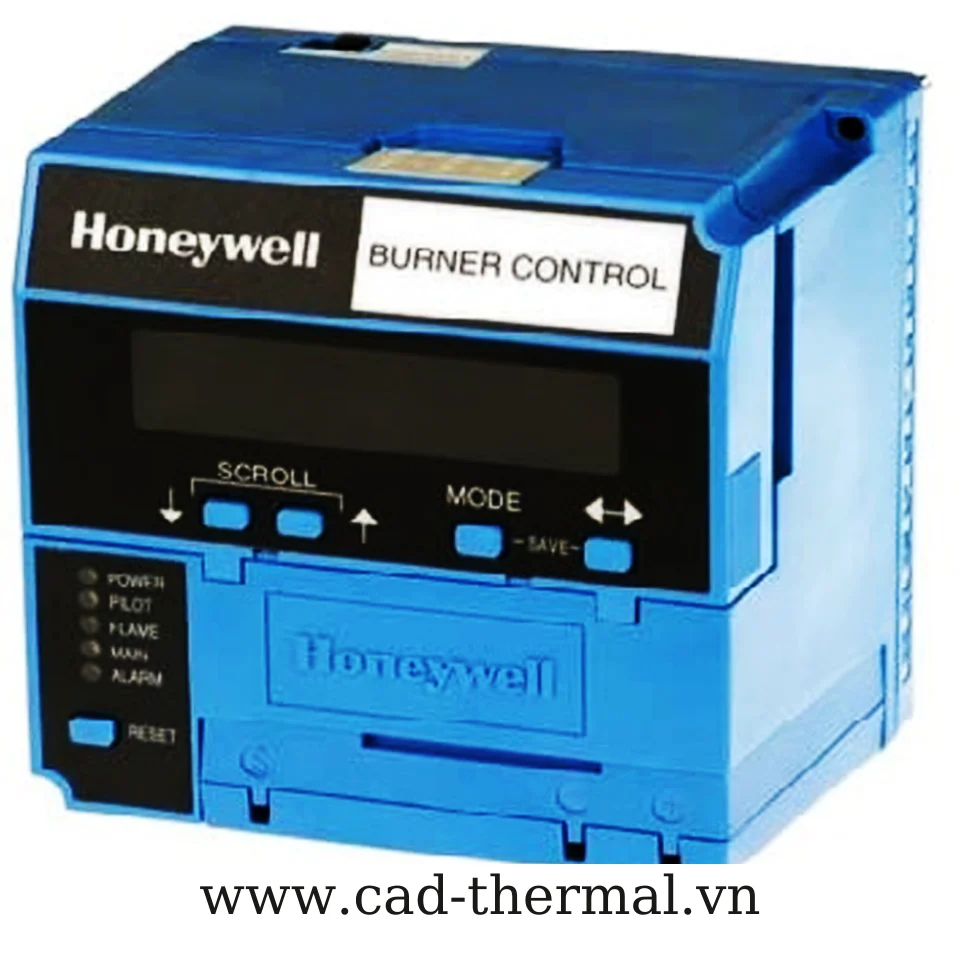
- Honeywell EC7823A1004: 220 VAC supply, integrated flame signal amplifier, 5 LEDs showing each step of the sequence; for single oil or gas burners.
- Honeywell RM7885A1015: 120 VAC supply, On-Off control, for single oil or gas burners, with an optional air flow check. Per the product pages, both codes use the Q7800 wiring subbase and the flame signal amplifier modules of the RM7800 family.
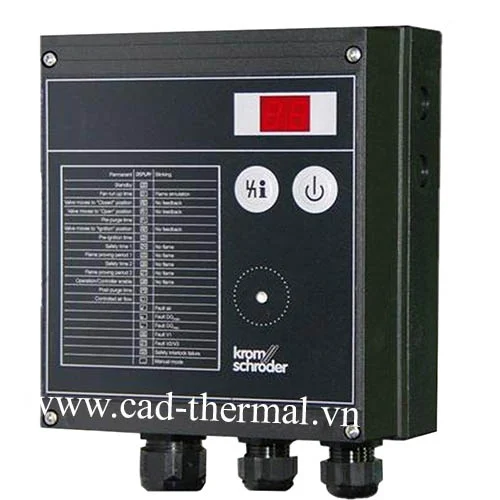
- Kromschröder BCU 370: controls, ignites and monitors forced-air gas burners; flame signal ionisation 1 – 28 µA or UV 1 – 35 µA, IP 54, ionisation/UV cable up to 50 m.
How to choose a burner controller
- Fuel and pilot type: gas, oil or both; intermittent pilot, continuous pilot or direct spark ignition.
- Number of burners and operating mode: one or several burners, On-Off or modulating, intermittent or continuous operation. Burners that run continuously often have extra requirements for a self-checking flame sensor.
- Flame sensor type: flame rod, UV or IR, and the matching amplifier.
- Supply voltage, operating temperature, enclosure rating and whether the location is hazardous.
- Standards and approvals: for example CSA, UL, FM or CE to EN 298, checked on the product page; make sure they match the project and the furnace manufacturer’s requirements.
- Display and communication: a local or remote display, connection to a PLC or SCADA system.
- Match with the gas train: the controller must open and close the right shut-off valves and read the right pressure switches of the gas line.
Need a burner controller or flame sensor that fits your existing burner? CAD supplies genuine equipment with full CO/CQ documentation. Send the model / specifications and CAD will quote within 24 working hours: contact CAD.
Frequently asked questions
Is a burner BMS the same as a flame safeguard?
In practice almost. A flame safeguard is a dedicated microprocessor form of burner BMS; a BMS can also be built on a safety PLC.
Does a burner BMS adjust the air-gas ratio?
In principle that belongs to the combustion control system. Many modern controllers combine both functions, for example the Kromschröder BCU 370, which controls the fan and butterfly valves.
When does a BMS lock out and need a manual reset?
When no flame is proven within the trial-for-ignition time, when the flame is lost for longer than the flame failure response time, or when an important interlock fails. Find the cause first, then reset by hand.
How do NFPA 85 and NFPA 86 differ?
NFPA 85 applies to boilers and related combustion systems (boilers with a fuel input of 3.7 MWt or more). NFPA 86 applies to ovens, dryers and industrial heating equipment.